HDS netTV Simulcast Client
The HDS netTV Simulcast client allows you to broadcast a video signal on your network using IP multicasting to other HDS ViewStations equipped with HDS netVideo software.
Start the HDS netTV Simulcast client from the window manager's pull-down menu. Hold down the right mouse button on the root window and select the HDSperx sub-menu. Click on HDS netTV Simulcast.
HDS netTV Simulcast displays the current video input in its window, typically from your camera or VCR or from the tuner.
Click on the buttons to "Send Video" and "Send Audio" to broadcast the signals. This sends the audio and video signals to a multicast IP address (the default is 224.2.1.1) where it can be received by any ViewStation on the network. (The values for the multicast address and the video/audio ports are selectable from the "Network Addressing" option of the Simulcast client.)
Note that the Simulcast can be sent in two sizes, 160x120 or 320x240.
HDS netTV Simulcast Client
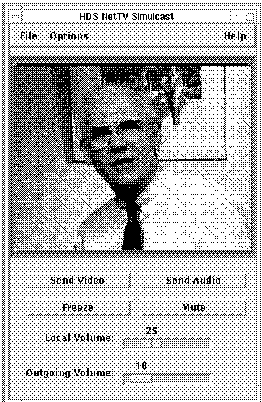
The HDS netTV Simulcast client offers a number of options:
The "File" menu offers a "Quit" option.
The "Options" menu offers four submenus (discussed below)
Video Controls - to control the local video image
Audio Controls - to control the local audio signals
Network Controls - to control the impact of simulcasting on the network
Network Addresses - to select address and port variables for multicasting
There are also buttons for "Send Video" to broadcast the video or toggle to stop the transmission. You can also "Freeze" the video image. There are also buttons to "Send Audio" to broadcast the audio or toggle to stop the transmission. You can also "Mute" the local audio. All of these buttons are toggle buttons.
There are slider bars for Local Volume and Outgoing Volume.
The "Audio level:" bar is a signal strength meter that continuously monitors the audio level, with green levels indicating good audio and red levels indicating too much volume.
The Video Controls - HDS netTV Simulcast Menu
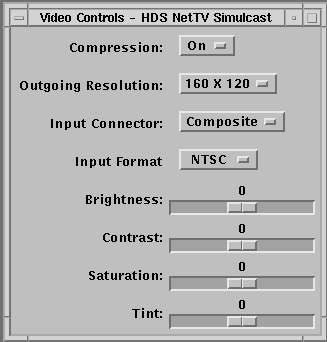
The Video Controls menu offers a number of selections.
Compression - This controls the quality of the video image. A slider bar for this variable is available on the "Network Controls" menu. There are three compression selections available: None, CellB, and HDSGrey. None indicates no compression of the images. CellB indicates that the ViewStation uses CellB compression (adjustable with the "Quality" slider on the Network Controls menu). HDSGrey indicates that the image color is discarded in order to improve the transmission frame rate.
Outgoing Resolution - 160x120 or 320x240. This is the actual pixel size of the transmitted image. Note that the larger image has 4 times as many pixels, with corresponding impact on the network. (Note also that the HDS netTV viewer client has options to enlarge the received image. This is frequently the better choice as it reduces the network traffic.)
Input Connector - Composite or SVideo. You would use this only if you have an SVideo input connector.
Input Format - NTSC, PAL, or SECAM.
There are four slider bars for adjustment of the video image:
Brightness
Contrast
Saturation
Tint
The Audio Controls - HDS netTV Simulcast Menu
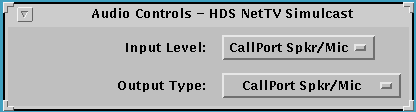
The Audio Controls menu offers two selections:
Input Level - Unspecified, HDS ViewCam, HDS Headset, CallPort Spkr/Mic, HDS Microphone, HDS Tuner, VCR, and Line Level Audio.
Output Type - HDS Internal Speaker, External Speakers, HDS Headset, and CallPort Spkr/Mic.
The Network Controls - HDS netTV Simulcast Menu
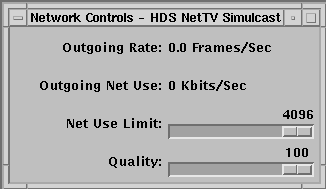
The Network Controls menu reports network usage (frame rate and network load) and allows you to set some variables to control the impact of multicasting on your network.
Net Use Limit slider bar allows you to set a maximum network usage value. This variable sets an upper boundary for network use by the simulcast. Decreasing this value can result in reduced frame rates. The setting appropriate for your network is dependent on your network environment.
Quality slider bar selects the amount of compression done to the video images by the ViewStation. Quality of 100% is maximum video quality (and probably a reduced frame rate). Quality of 0% means maximum compression, so you will have a relatively high frame rate but somewhat less video image quality.
The Network Addresses - HDS netTV Simulcast Menu
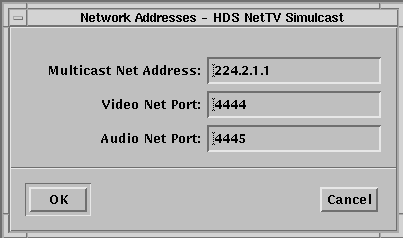
The Network Addresses menu allows you to set several network variables.
Multicast Net Address - the default is 224.2.1.1; other multicast addresses are permitted with the IP protocol. You can also enter an address for a specific View Station if you want to restrict the viewers to a single ViewStation.
Video Net Port - the default port is 4444; you can select another port number.
Audio Net Port - the default is 4445; you can select another port.
These addresses and ports allow selection of video signals like TV channels, the sender and receiver must have the same settings to receive the signal.
HDS netTV Simulcast Video Client Manual Page
This is the HDS netTV Simulcast client manual page.
 Return to the Home Page